When it comes to the traditional cultural space of the Vietnamese people, few images are as close, familiar, and significant as: "The buffalo is the foundation of one's career".
The buffalo is not merely a livestock animal or a source of draft power in the fields, but has become an integral, flesh-and-blood symbol of Vietnam's wet rice civilization.
There is an interesting fact that few people know: West Lake in Hanoi, before being named Dam-dam (Mist Lake) during the Ly Dynasty or Doai Ho, Tay Ho (Lake in the west of the citadel) under the Le Dynasty, was once called Golden Buffalo Lake. An ancient poem still reminds us:
''The Buffalo Lake has spanned three dynasties
The citadel of war still preserves the land of the Dragon's Navel''
Buffalo Lake and the Kim Ngu River, a branch of the To River flowing around the south of Hanoi from west to east, also evoke a legend from the mythological period of Vietnam: In the swampy area at the foot of Tien-Du mountain, there was a Golden Buffalo. A sorcerer used a staff to cast a spell on the buffalo's forehead. The buffalo struggled and charged south, trampling the muddy Khoai Chau area, which was later called the Buffalo Wallowing Pool. Not yet finished with its rage, the Buffalo swam across the Red River and ran north; the path created by the buffalo's footprints sank to become the Kim Ngu River. Then the buffalo ran in circles, causing an entire area to collapse into a swampy lake, and hid deep beneath it; that is the Golden Buffalo Lake. Legend has it that if a family gives birth to ten sons, those ten sons will be able to pull the Golden Buffalo up to enjoy its blessings. But since then, no family has ever given birth to ten sons...
The buffalo is a creature that adapts to warm, humid swamp ecosystems, living in herds with a leader. Around the swamp are lush forests with weeds and wild rice for the buffalo to eat. The wild buffalo Bubalus bubalis, the ancestor of domestic buffaloes, originally lived in the low, humid, tropical monsoon swamps of Southeast Asia. Not long ago, wild buffaloes were still quite common in the central part of our country. Wild buffaloes generally resemble domestic buffaloes but have wider and longer horns; they move faster and more gracefully than domestic buffaloes. In wild buffalo herds, there are also "albino" individuals called white buffaloes, similar to the phenomenon often seen in domestic buffaloes... Vietnamese archaeologists have found buffalo fossils in the Tham Khuyen, Phai Ve, Keo Leng, Hang Hum, and Tham Om caves... dating back several hundred thousand years. The primitive people of Lang Son and the ancient people of Hang Hum hunted wild buffaloes along with elephants, orangutans, tapirs, pandas, monkeys, and apes... to survive.
Since the era of the Hung Kings who founded the nation, the Buffalo has become an indispensable part of Vietnam's wet rice agricultural civilization. Surely every Vietnamese person has heard:
''On the dry field, below the deep field
The husband plows, the wife plants, and the buffalo harrows!''
From buffaloes pulling plows in the valley fields to buffaloes hauling timber in the high mountains, dragging loads without the need for wheeled carts... to the buffalo carts trudging along the Truong Son mountain roads described by Le Quy Don in Kien van tieu luc, the buffalo has fully shouldered the mission of livelihood for the entire Vietnamese nation. Even in the history of national defense, the buffalo has proudly stepped into battle: from the shepherd children playing war games with reed flags in Hoa Lu to the herds of buffaloes driven into the Hoang Long River to charge and break the formations of the Song invaders under King Le Dai Hanh. The buffaloes were given wine to get drunk and driven to charge and break the enemy's military formations. And buffaloes were also tied with fire torches to their tails and driven into the enemy camp in many fire-based attacks. Vietnamese buffaloes have joined the people in fighting the Chinese, the French, and the Americans.
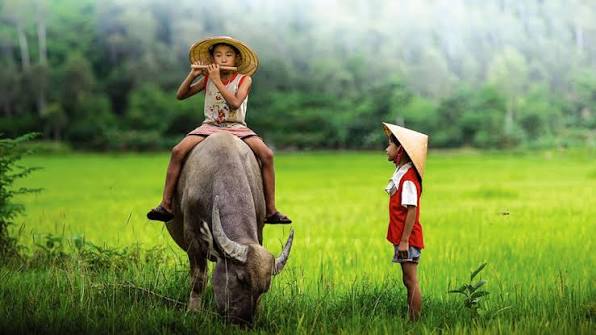
From real life, the buffalo entered the spiritual and mental world of the Vietnamese people as naturally as breathing. Terracotta buffalo statues and buffalo-head-shaped jewelry made of precious stones, thousands of years old, found at archaeological sites, are clear evidence of that position. The book Giao chau ky from the 3rd century recorded the peaceful image of Vietnamese children melodiously playing flutes on the backs of buffaloes in the village alleys. Evoking the image of a crescent moon, the buffalo is also associated with the water buffalo legend and the worship of the moon and water in coastal areas, such as the buffalo fighting festival during the Do Son festival, which signifies the renewal and replenishment of the vitality of Heaven, Earth, and Humanity.
Through all the ups and downs of time, even as machines and the pace of mechanization are gradually appearing in our hometown fields, the image of the buffalo strolling in the sunset remains an immutable symbol of diligence, patience, and prosperity. The buffalo stands there, silent and persistent, fully embodying the soul of the countryside and the source of traditional Vietnamese culture.
Ready for the journey?