When I officially stepped deep into the territory of the local people, all my initial prejudices or poor imaginings of a desolate land were completely shattered by the strangely vivid details.
The terrain here is like a natural maze formed by jagged, vertical mountain ranges. The Ka-Tu trails head straight forward, plunging into rivers and then plunging into rivers again, climbing mountains, the steepest mountains. They are often slippery and infested with leeches. Even though there are few large game animals in the forest, the forest is still very lively.
The forest wakes up at dawn with the joyful cries of monkeys, followed by the crowing of chickens, peacocks, and talkative mynas, all joining the symphony before noon makes the scenery sluggish as if everything were sleeping; at sunset, one hears the barking of deer, then the noisy crickets, night birds, and the rustling of thousands of insects, these sounds signaling to the father of the forest: the tiger lord, it is time to hunt.
Ka-Tu means wild; during my travels, I asked the Moi people I met: "Where are you from? We are the (mo nui) people of such and such village. Do you know the Ka-Tu people? Yes, those are the people up there, in the mountains."
And up there, in the mountains, they pointed me to other mountains on the Lao side. However, I do not conclude that wild people do not live in that area! Thank goodness, they are very numerous, living scattered in many small villages in the Ben-Hien area, and in large villages in the Sau outpost area. The Put valley and the A-Ro, Ya Yin Na Bot pass certainly have a migration route (that is surely the layout of Route 10 if this road is to be built one day). That is what explains the Lao influence certainly present in the region. People are wealthier and seem to be sedentary, while those in the Ben-Hien area are all poor and nomadic; these people have the "bavak"* tree (a palm tree for making wine) which they abuse. They are plumper and have white teeth, while the others have black and filed teeth; they are more moderate and more intelligent. But alas, they are thirstier for blood. Although they share the same language with few distinct nuances. (If you are interested in this language, we will study it in another article...)
The Ka-Tu people at the Sau outpost make a wine that is slightly alcoholic, with an interesting flavor that they love, extracted from a palm tree 5m-6m high whose crown bears long fruit clusters with fronds drooping into a dense clump. They take great care of this tree, and the relatively good trails are those leading to the "bavak" groves. This palm tree is very special in the A-Put valley. I do not think other Moi tribes in the Truong Son range know this tree. It is the "Doac" tree to the Annamese in Thua Thien and Quang Tri. Moreover, drinking bouts are the main feature of a Ka-Tu festival. A Ka-Tu person will say: "Yesterday I was drunk," to explain that there was a festival in his village yesterday.
The Ka-Tu people we know do not have any technology. Essential items including pottery, iron spearheads, jewelry, and blankets are provided by the Annamese, or by the famous Ka-Taouat, about whom we know almost nothing. Exchanges with the Ka-Tu are made via the A-Sap, A-Tep, and A-Vuong valley routes, or by the Dak-R'gneis, Sa-Mo, Le-Tia river routes, or through the Put valley with the Ta-Riu people. Exchanges with the Annamese are carried out at Ben-Giang and Ben-Hien, the ends of the waterways of the Cai and Con rivers.
The Moi people have always traded with the inhabitants of the plains, first the Cham and then the Annamese, because it is only through their mediation that the Moi can get enough salt for their food supply. Research into the relations between the Ka-Tu and the Annamese takes us far back into the past; Mr. Sogny stated: "Legend tells us that a long time before the Gia Long era, trade exchanges normally took place at Ha-Tan, 20km from the Con River in the lower reaches of the Ben-Hien River, which is the current market." That was certainly the period when the Annamese land encroachment had not yet reached the western boundary of the plains, some locations in Quang Ngai. To this day, the Moi still live in the delta region that the Cham had to cede.
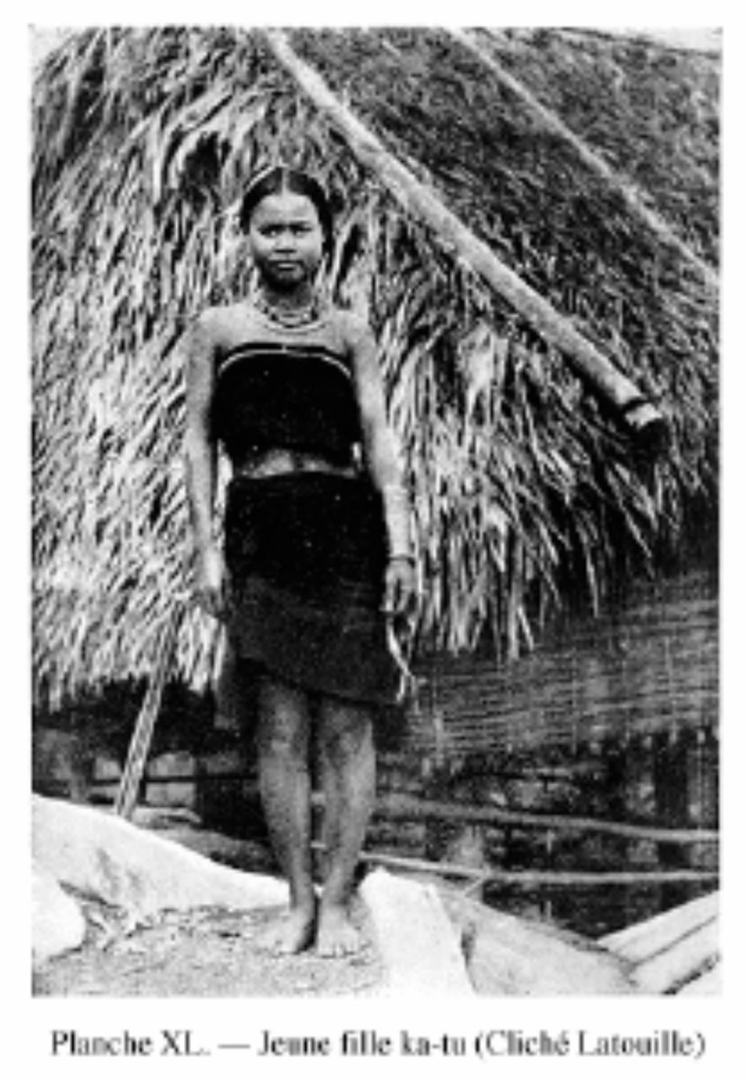
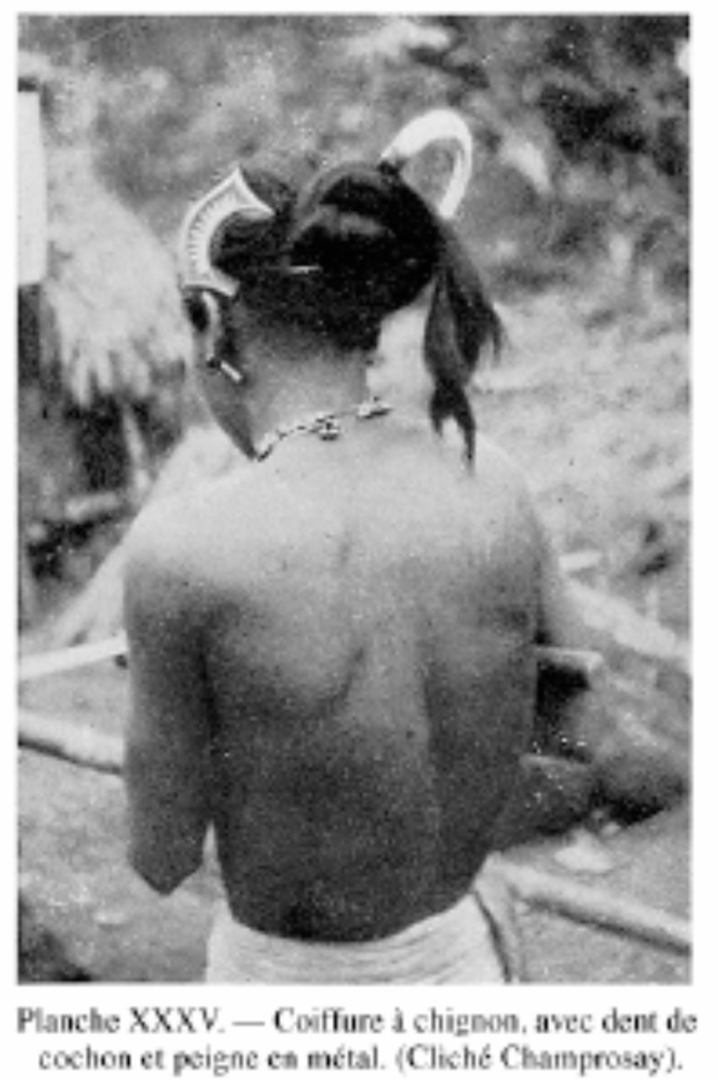
The everyday attire of the Ka-Tu consists of a long blue cloth cover and a loincloth, sometimes decorated with small lead rings, originating from the Ka-Taouat people. Especially in a village two days' walk to the west, some people wear strange clothing. A kind of iron chainmail armor made of iron rings linked together and threaded into fabric. Could it be a souvenir from ancient times? And did their ancestors once wear armor? The men's hairstyles are very strange and interesting, with most wearing a bun adorned with a bronze comb and a boar tusk.
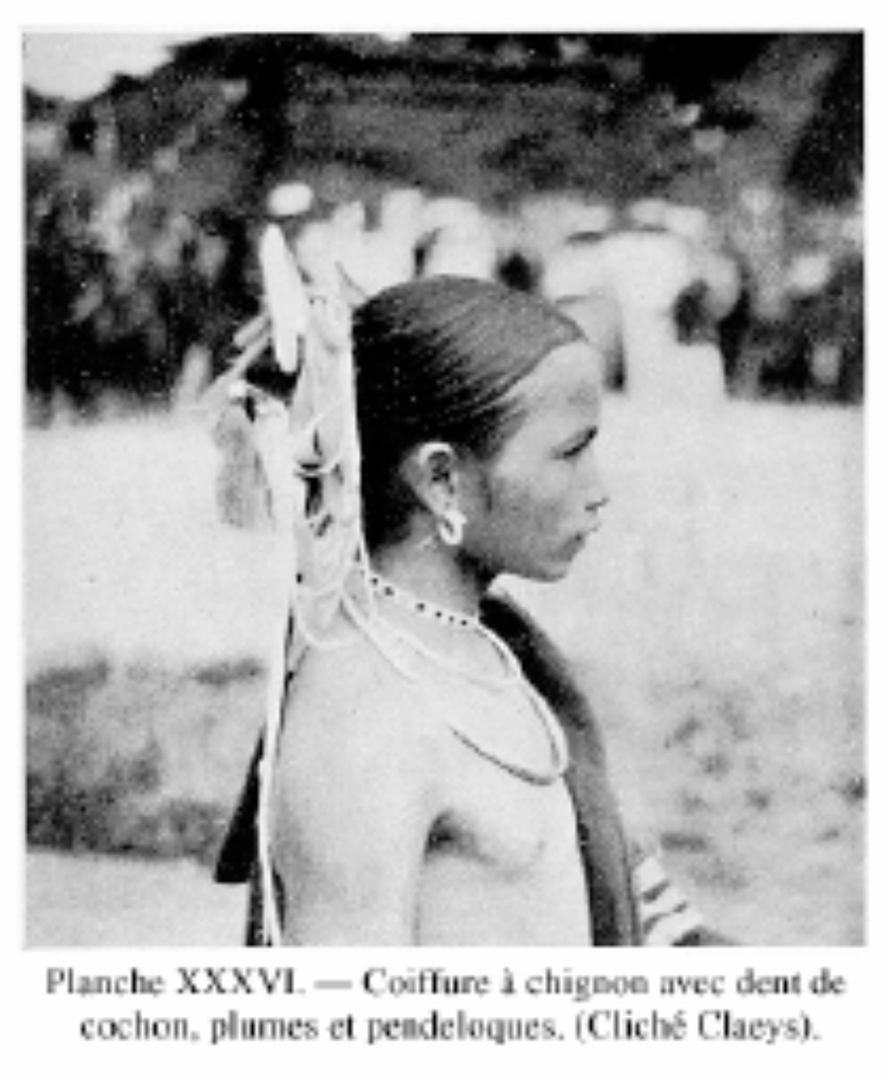
Pigs are raised in a special way; for this purpose, the upper molars are pulled out to allow the lower tusks to grow freely; these animals are fed with pig bran for seven years. At this age, the tusks are 10cm-15cm long and the ivory is very fine. Each such pig is worth two buffaloes.
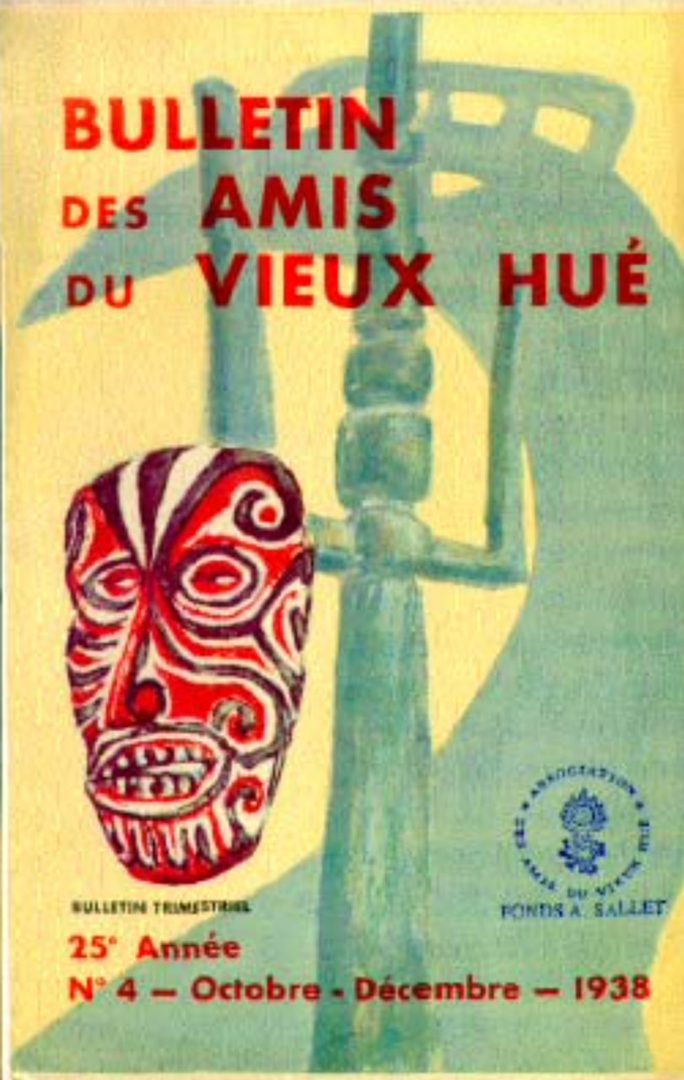
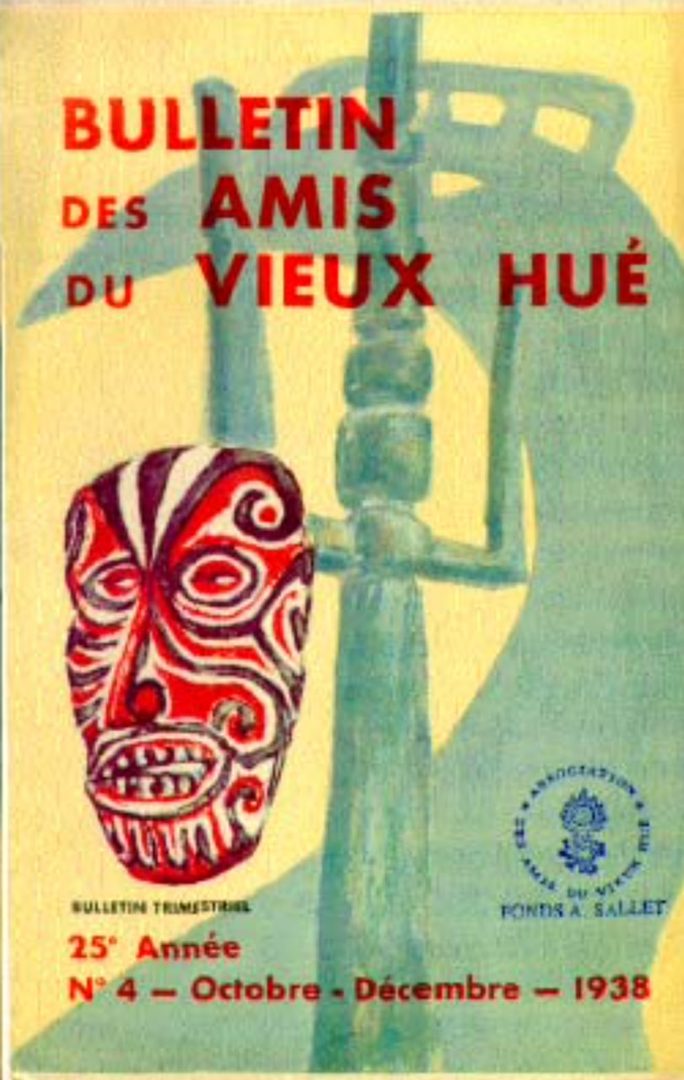
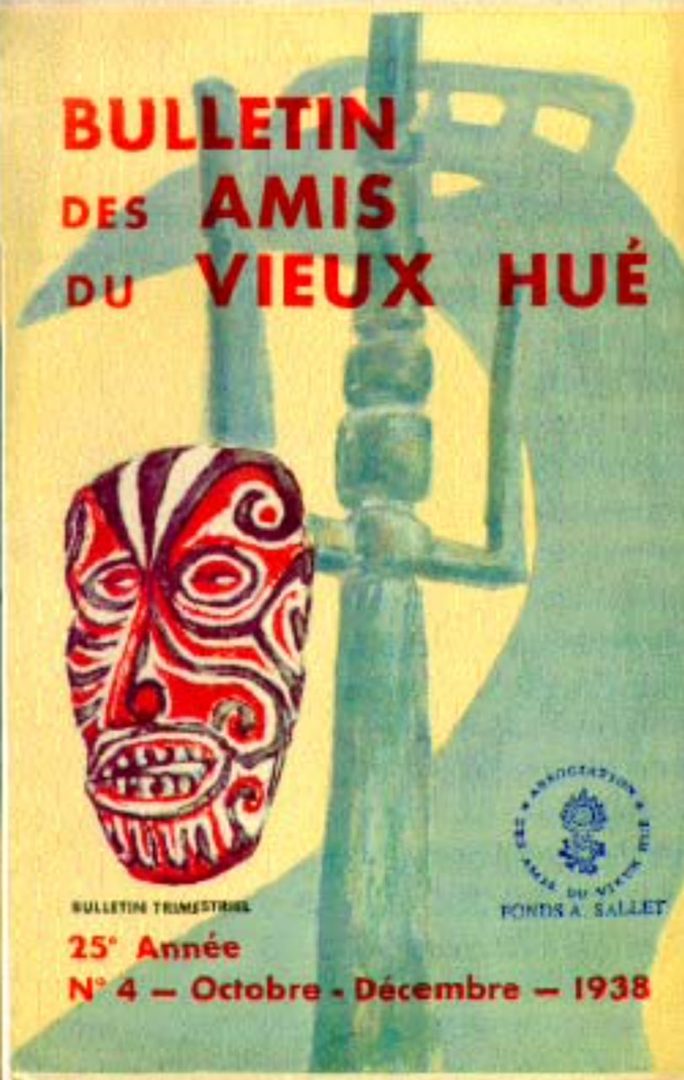
Some Ka-Tu people wear their hair in a dog-style like the Se Dang people. Others in the Sau outpost area wear a bamboo ring on their heads decorated with buttons like some Lao people. Those in the A-Taouat area trim their eyebrows into a very thin line and draw them very carefully like our elegant French ladies. They often have strange tattoos: on the forehead, the image of "Padil yayah" (Dancing Woman); on both cheeks, two suns; both eyebrows extended by a series of large black dots to the upper part of the ears. On their bodies, they have stars and crosses tattooed.
I cannot understand the meaning of these tattoos. Women often wear bamboo strips like bird crests in their hair. They wrap themselves in blue cloth up to below the breasts, and the breasts are covered by a strip of cloth of the same color. Jewelry is abundant and miscellaneous, from long and heavy bronze bracelets to wooden or bone earrings, sometimes even a ten-cent coin. Necklaces are very diverse, made of iron, colored glass (beads), buttons, and seashells.
The Ka-Tu also wear many amulets to avoid illness. One day, I met a resident wearing a bottle cap on a necklace... an Annamese had sold it to him as a very effective remedy for stomach aches! They certainly like anything shiny and are quite vain.
Some of the Ka-Tu have become true wild beasts. Certainly due to constant internal wars, they all had to flee as refugees into the rugged mountains that are almost inaccessible at the headwaters of Len and Ba Nao. They build poor huts, cover themselves with animal skins, and live only on what they can find in the forest. Their honesty is almost infinite (the famous honesty of the Moi). One cannot be angry with them. The gods are very powerful.
The Ka-Tu are arrogant, boastful, and pompous, but hospitable and quite brave. They are mocking and talkative, good walkers, and very simple. In the Ben-Hien area, they place little value on human life, and their greatest hunt is the blood hunt. And we will see this hunt in a later part.
One day I asked Ta ka (Village Elder) in Ca lang, who told me about a military expedition he had carried out near A-Ro, four days' journey from his house:
- "What did those people do to you?"
- Nothing.
- Then why kill them?
- He laughed and replied calmly: For fun!
They grow cassava, corn, and rice. They use them to sustain themselves. They engage in animal husbandry, raising pigs, buffaloes, chickens, and in some villages, they even raise goats. In the forest, they find betel, medicinal plants, and fruits that they sell to the Annamese; tubers and vegetables are their basic food source. When cooking, they preserve meat in bamboo tubes, often with layers of salt.
At mealtime, they heat these tubes near the fire. The wild people in the New Hebrides do the same. That is not the only thing they have in common. They hunt in many ways, either by traps, by dogs, or by crossbows. The Moi in A-Taouat are famous passionate hunters; they hide in small thickets or in a large tree and call birds or muntjacs and wild goats by imitating their cries. When the animal approaches, they shoot arrows at it, often poisoned arrows.
Normally they only eat two meals a day, breakfast at cockcrow and the afternoon meal at sunset. In the Sau outpost area, they drink "doac" (bavak) wine which has a slightly sour, slightly astringent, and quite pleasant taste. In Ben-Hien, they ferment various things in jars: rice, cassava, or even corn, but they only drink on major festive occasions, for example, when outside dignitaries come to visit...
Please continue reading part 3...
Ready for the journey?