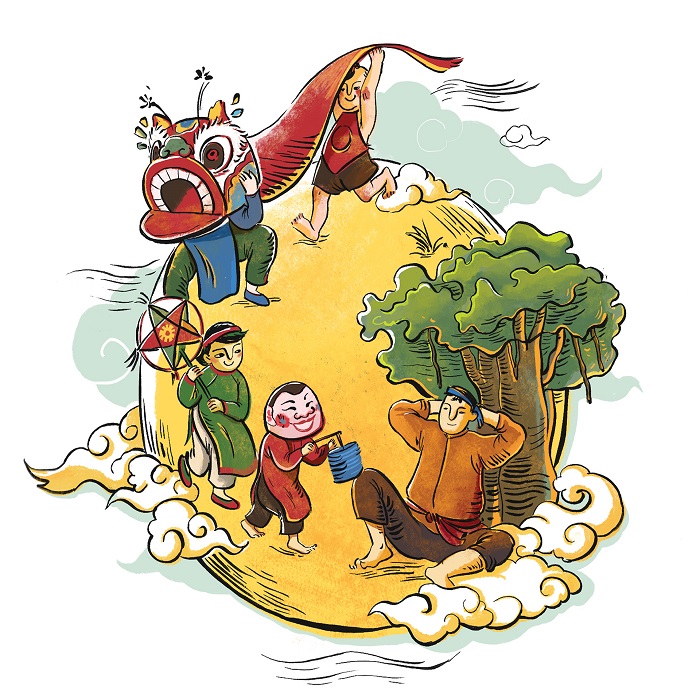
"Cuoi sits by the banyan tree,
Letting the buffalo eat the rice, calling for father, oh, oh..."
Every mid-autumn, a nameless nostalgia pulls us back to the moons of the past, to the corner of the yard, and the clear laughter of childhood.
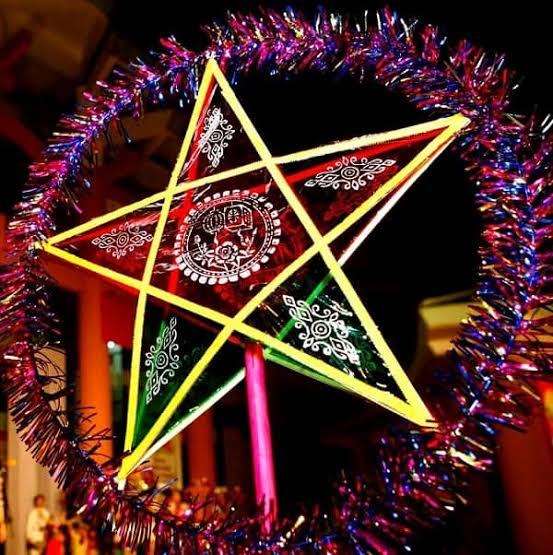
The Mid-Autumn Festival of us poor village children began with afternoons spent gathering in groups to chop old bamboo, painstakingly whittling the slats until they were smooth, and bending them into five-pointed stars. With a few sheets of red cellophane glued on with lime paste and jackfruit sap, we would all end up covered in sticky mess. The lantern smelled of glue and sap, but once the candle was lit, it illuminated the whole yard.
The moon-viewing feast back then was rustic, or more accurately, simple. There were no imported candies or elaborate platters, just a few ripe, soaked persimmons freshly picked from the garden corner, a wrinkled Dien pomelo that mother would carefully peel into pristine segments and arrange like flower petals next to a fragrant bunch of spotted bananas. The packed-earth yard was swept clean, a few tiny bamboo stools were gathered around, and that was enough for a lively festival night filled with crisp laughter.
On the night of the fifteenth of the eighth lunar month, the sky was vast and clear, embracing the perfectly round moon. The autumn moon was like a giant silver mirror hanging over the village bamboo, gentle and warm like the embrace of a grandmother or mother. Children called out to each other, running through the alleys, the sound of drums beating rhythmically to the lion dance steps of the older ones. Everyone was covered in sweat, skipping about, unable to sit still. And somewhere in the gentle breeze, the scent of pomelo blossoms from someone's garden drifted by.
And there, the image of Cuoi sitting sadly under the banyan tree is childhood itself, an entire sky of memories that we carry throughout our lives. The verse wobbles like a child's voice, yet it is filled with the sorrow of homesickness. Cuoi left his village, his neighborhood, and the warm smoke of the kitchen to endure loneliness alone on the high moon. And so, whenever the moon is at its brightest, the call "father, oh, oh" in that vast expanse turns into a heart-wrenching longing for home.
It turns out that no matter how beautiful or golden the moon may be, it cannot fill the longing to belong to a home. Cuoi on the moon is like us children when we grow up. We wander to distant lands, pass through many moons, and achieve many things, but every time the fifteenth of the eighth lunar month arrives and we look up, our hearts swell with a desperate yearning to be small again, to hear the call of our parents, and to have a family meal together.
The Mid-Autumn Festival has never been a holiday just for children. It is the simplest excuse for adults, tired after days of struggling, to be allowed to rest. To slowly brew a pot of bitter green tea, cut a piece of sweet mung bean mooncake, and sit quietly with loved ones. No matter how the world outside changes or how far the rhythm of life carries us, the moon of the fifteenth of the eighth lunar month is still there, silently shining into each person's soul. So that we know how to cherish what we have, feel the ache for the gaps that need filling, and find our hearts softened after the storms of life.
Tonight, the moon is bright outside the porch. May you find a small, peaceful corner, look up at the round and clear moon above, and feel yourself fully embraced by the warmth of family and the feeling of returning home.
Vietnamese culture is as simple as that...
Ready for the journey?